
Case Study: EU Battery Regulation and its impact on light electric vehicle manufacturer Cake
Executive Summary
The case study evaluates if Cake's current lineup of batteries comply with the EU battery regulations which entered into force in 2024. The regulations aim to reduce the environmental impact of batteries in the EU throughout the battery's entire life. Promoting a cyclic rather than a linear economy. The requirements were categorized into three categories, active requirements, which must be fulfilled now, short term requirements, where work needs to be started now to ensure compliance when they enter into force, and finally long term requirements are more than 2 years away. Cake batteries today do not comply with the short term requirements and work to resolve these non-compliances has already started. The short term requirements must be finished by February 2027 where Cake already complies with one of them and start working with a partner to be ready for the battery passport. To comply with the long term requirements Cake should wait for larger actors to develop a waste management network and find a partner for carbon footprint declaration as the tasks are too demanding for Cake on its own.
Introduction
Cake is a small company producing light electric vehicles for the European market, focusing on delivering high performance premium products. Their product category ranges from smaller mopeds to light motorcycles for on- and off-road use. Cake also aims to disrupt the status quo and reshape the electric mobility landscape, striving for zero emissions and respecting the environment. Compliance with the battery regulation is highly important to Cake, not only from a technical point of view but also to maintain its focus on sustainability. This case study focuses on evaluating how the European Battery Regulation affects Cakes batteries, what changes are necessary to ensure the products are compliant and how to remain compliant when more requirements enter into force. Staying on top of the requirements to avoid expensive mistakes and misses. The battery regulation is relevant for all integrated batteries, regardless of chemistry and composition and in this case study any company developing products with integrated batteries which are sold in the EU.
EU Battery Regulation
The EU battery regulation (Regulation 2023/1542] covers almost all batteries placed on the EU market with the aim of decreasing the environmental impact of batteries throughout the full life-cycle. The regulation is necessary due to the significantly increasing demand for batteries in a wide variety of applications. The demand for batteries is projected to increase 14 times by 2030, according to the European Commission. The entity placing the battery on the EU market is responsible for the battery being compliant with the regulation and the key topics addressed in the regulation include:
- Digital passport for batteries, including technical data, recycling procedure, manufacturer contact information and more, Supply chain due diligence
- Carbon footprint
- Replaceability and removability of LMT and portable batteries
- End of life management for the batteries
- Performance and durability requirements, including increased testing for safety, data on the batteries state of health and more
- Increased demands for declaration of conformity and CE-marking.
The implementation of the requirements above are staged with the increased demands for declaration of conformity and CE-marking entered into force in August 2024 while the requirements for recycled contents in the battery is scheduled to enter into force in August 2033. Staging allows manufacturers to ease into the new requirements gradually without big disruptions.
The timeline for LMT batteries is visualized below.
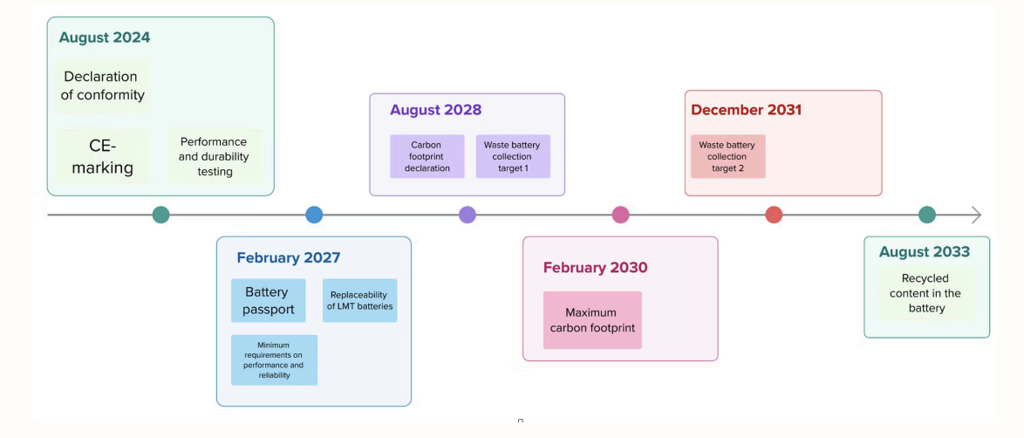
- August 2024: Declaration of conformity, CE-marking, Performance and durability testing
- February 2027: Battery passport, Replaceability of LMT batteries, Minimum requirements on performance and durability
- August 2028: Carbon footprint declaration, Waste battery collection target 1
- February 2030: Maximum carbon footprint
- December 2031: Waste battery collection Target 2
- August 2033: Recycled content in the battery
The regulation uses the battery size and use to classify the batteries into five categories, portable batteries, starter, lighting and ignition (SLI batteries, Light Means of Transport (LMT) Batteries, Electric Vehicle (EV) Batteries and industrial batteries. Cake batteries fall into the LMT or EV category.
Current position
The two Cake platforms covered in this study are a moped (AM-license) called Makka and a light motorcycle (A1-license) called Ösa. In total, there are two batteries per platform. Thus, four different batteries are evaluated. The details on the batteries are described in the table below.
| Specification | Makka Regular | Makka XL | Ösa Regular | Ösa XL |
|---|---|---|---|---|
| Nominal voltage | 48 V | 48 V | 51.8 V | 51.8 V |
| Weight | 12 kg | 24 kg | 18 kg | 26 kg |
| Capacity | 31 Ah | 62 Ah | 50 Ah | 70 Ah |
The main features of the Cake batteries is that they are portable and designed to be taken out of the vehicle quickly and easily. Allowing the batteries to be charged anywhere without the need for an outlet next to the parking spot. It's one of Cake's selling points, together with different types of batteries, highlights the product's versatility and adaptability depending on the customer's needs. Cake batteries, although similar, are different and the variations add additional layers of complexity in order to keep track of data and processes. The technical matureness of the batteries also varies, increasing the complexity further. All batteries are designed and manufactured according to the industry standards when it comes to safety and reliability. The batteries have been updated during their lifetime to be compliant with the demanding UL2271 certification. UL2271 focuses on the safety of the batteries, both electrical (over-charging, temperature, short circuit etc.) and mechanical [IP-rating, shock, vibration, temperature cycling etc.) and during these tests, the batteries are not allowed to catch fire, leak electrolyte, or become dangerous is any way.
Impact of the Regulation
Diving deeper into the requirements and timeline of the regulation allowed us to evaluate and categorize actions into three categories, active requirements, short term requirements and long term requirements. Active requirements are requirements that must be satisfied now, short term requirements enter into force within two years and long term actions enter into force in more than two years. In order to ensure compliance with short term requirements, work should be started as soon as possible while work on long term requirements can wait. The requirements are staged differently based on the category of the battery. EV batteries are subject to a stricter timeline and tougher requirements compared to LMT batteries. Cakes vehicles have a weight of less than 100kg with battery weight below 25 kg and thus the LMT categorization makes sense. In the table below the requirements on an LMT are stated.
| Requirement group | Requirement | Entry into force | Category |
|---|---|---|---|
| Classification | Weight is less than 25 kg | August 2024 | Active requirement |
| Classification | Battery is sealed | August 2024 | Active requirement |
| Classification | The battery is specifically designed for this use. | August 2024 | Active requirement |
| Declaration of conformity and CE-marking | Declaration of conformity | August 2024 | Active requirement |
| Declaration of conformity and CE-marking | Battery is properly labeled, CE-mark, manufacturer information etc. | August 2024 | Active requirement |
| Declaration of conformity and CE-marking | Technical documentation is compiled and available | August 2024 | Active requirement |
| Performance and durability testing | Specific performance and durability metrics must be tested and made available | August 2024 | Active requirement |
| Removeability and replaceability | LMT batteries must be replaceable without the need for specialised tools at any point during the product's lifecycle. | February 2027 | Short term requirement |
| Performance and durability Requirements | Minimum requirements on durability and performance must be met. | February 2027 | Short term requirement |
| Battery passport | Every battery must have a unique passport accessible with dynamic data regarding the technical specifications, recycling information and more | February 2027 | Short term requirement |
| Carbon footprint | The carbon footprint of the battery must be evaluated and shared | August 2028 | Long term requirement |
| Waste collection target | The company must meet the 51% waste collection target | December 2028 | Long term requirement |
| Maximum Carbon footprint | Maximum carbon footprint for batteries. | February 2030 | Long term requirement |
| Waste collection target | The company must meet the 61% waste collection target | December 2031 | Long term requirement |
| Recycled content in battery | The battery must contain a certain amount of recycled material | August 2033 | Long term requirement |
The long term actions are not evaluated further due to the distant timeline and unreleased performance and reliability requirements.
Evaluating active requirements
The short term actions focus largely on the technical aspects of the batteries and have been evaluated together with the technical team at Cake, with input from the sales team when necessary.
Classification of batteries according to the Battery Regulation
All batteries must be classified as LMT batteries under the battery regulation definition,
- Battery is specifically designed for use in a light means of transport vehicle, including L category vehicles under regulation 168/2013.
- Battery is sealed
- Battery weight is less than 25 kg
- Is not an electric vehicle battery
The moped is classified as Lie-B and the light motorcycle can be classified as either Lie-B or L3e-A1 under regulation 168/2013. Sealed is defined as the contents of the battery does not need to be refilled, accessed or replaced during normal operation while protecting both the battery and user from leakage or water ingress. By that definition the Cake batteries are sealed. Second to last, the battery weight must be less than 25 kg. This is true for the Makka, Makka XL and Ösa batteries but not the Ösa XL battery as it weighs 25.5 kg. The additional 0.5 kg must be removed and a thorough discussion together with the sales team reached consensus that a reduction in performance (Power, range etc.) is not acceptable. If the Ösa XL battery weight remains at 25.5 kg, the battery will be categorized as an EV battery meaning there is need for a carbon footprint declaration and have a certified State of Health. Significantly more effort compared to an LMT battery.
Safety, performance and reliability
The new requirements on performance reliability are focused on measuring a number of specified parameters. No minimum requirements are set but the parameters must be measured and made available if requested. Most parameters are not measured today and must be tested immediately, as well as updating the battery software with expected lifetime parameters which are missing. The regulation states that batteries must be designed and manufactured to optimize performance, durability, safety and minimize the environmental footprint. Safety, performance and longevity is the core of Cake's design philosophy. On top of the design philosophy the regulation lays down two requirements, the first being availability of State of Health (SOH) and expected lifetime data. The data should be available for read-only access from the Battery Management System (BMS). The second requirement are performance and reliability parameters to be made available to relevant authorities. Minimum requirements will then be imposed in 2027 and no values have been determined. Any potential work regarding the minimum requirements will be left until the values are determined.
The data to be made available from the BMS are divided into two sections, SOH and expected lifetime parameters.
SOH parameters,
- Remaining capacity
- Remaining power capability
- Remaining round trip efficiency
- Evolution of self-discharge rate
- Ohmic resistance
Expected lifetime parameters,
- Date of manufacture and where appropriate, date of putting into service
- Energy throughput
- Capacity throughput
- Tracking of harmful events
- Number of full equivalent charge-discharge cycles.
After evaluation together with the technical team at Cake, the SOH parameters round trip efficiency and ohmic resistance are very difficult to implement in this use case and discarded. Power capacity is an interesting parameter which could be useful for the user and is not implemented. The self-discharge rate is also missing. For the expected lifetime parameters, the date of manufacture, capacity throughput and number of equivalent charge-discharge cycles are already implemented and available. Tracking of harmful events is currently being worked on. The energy will be implemented in the same software update.
The performance durability parameters required to be measured and reported are
- Rated Capacity in Ah, including applied charge and discharge rates
- Capacity face in %
- Power in W and the ratio between power and energy stored
- Internal resistance in Ohm and the depth of discharge during cyclelife testing
- Internal resistance increase in %
- Where applicable, energy round trip efficiency and power at 80% and 20% state of charge.
- Expected lifetime under reference conditions based on the actual use of the battery in cycles or calendar years depending on the use case.
- Includes any explanations of calculations.
The regulation does not specify any requirements on the measurement method. Using the European standard EN 50604-1 was decided together with the battery manufacturer. Additional testing is to be carried out in accordance with EN 50604-1.
Declaration of conformity
Before the battery is placed on the market an EU declaration of conformity must be done. This includes multiple steps with the goal of providing the necessary documentation and rationale for validation of conformity with all applicable EU regulations. Cake decided to perform an Internal Product Control evaluation as the batteries are manufactured in series and the requirements on carbon footprint and recycled contents are not mandatory until 2028 and 2033 respectively. This allows the process to be done without a notified body. The process includes the following steps,
- A CE-mark must be affixed to the battery,
- The battery must be correctly labeled with the following information,
- a. Name of Manufacturer, registered trade name or trade mark. Including address and a single point of contact. If available a web or email address.
- b. Serial number or other unique identified of the battery
- c. Geographical place of manufacture
- d. Year and month of manufacture
- e. Weight
- f. Capacity
- g. Chemistry
- h. Potential hazardous materials, except Lead and Cadmium
- i. Extinguishing agents to be used
- j. Critical raw materials which concentration exceeded 0.1% of weight to weight
- k. From 2027, a QR-code with information regarding the battery passport.
- Technical documentation including,
- a. General description of the battery it's intended use
- b. Conceptual design and manufacturing drawings and schemes of components, sub-components and circuits.
- c. Descriptions and explanation to the documents in section b, as well as operation of the battery
- d. Specimen of the label
- e. List of harmonised standards or descriptions of technical solutions used to comply with the requirements of regulation. For verification of compliance
- i. Low Voltage Directive
- ii. UL2271
- iii. Testing according to EN 50604-1
- f. Results of design calculations
- g. Test reports
- Manufacturing process conformity
The technical documentation must verify the compliance of the following requirements,
| Article | Description | Requirement |
|---|---|---|
| 6- Restriction of substances | The battery may not contain any restricted substances | Set out in Regulation 1907/2006 |
| 7-Carbon footprint | The carbon footprint must be declared per model and manufacturing plant | Not applicable until 2028 |
| 8 - Recycled content | A certain percentage of recycled content must be used. | Not applicable until 2033, |
| 10- Performance and durability | Parameters on performance and durability must be measured and reported | Rated Capacity [Ah] and capacity fade [%] Power [W] and power fade [%] Internal resistance [Ohm] and internal resistance increase [%] Energy round trip efficiency [%] and its fade [%] Expected lifetime of battery in specific conditions in cycles or calendar years. |
| 13 - Labeling | The battery must be correctly labeled | Manufacturer name Place of manufacture Date of manufacture, year and month Weight Capacity Chemistry Potential hazardous materials Extinguishing agents to be used Critical raw materials with concentration above 0.1% weight by weight |
| 14-State of health and lifetime information | The BMS must store and make available on request information on the state of health and expected lifetime | Parameters for state of health Remaining Capacity Where possible, Remaining Power capability Where possible, remaining round trip efficiency Evolution of self-discharge rates Where possible, ohmic resistance Parameters for Expected lifetime: Date of manufacture and/or date of putting into service Energy throughput Capacity throughput Tracking of harmful events Number of full equivalent cycles |
Short term requirements
Work on fulfilling short term requirements should start soon in order to ensure the batteries stay compliant.
Battery passport
The battery passport of the regulation is the most demanded section. Although not applicable for LMT batteries until 2027 the requirements are significant and work must be started early to ensure compliance. The battery passport must provide a large number of data points to the public and notified body, unique for each battery placed on the market. All with a QR-code printed on the battery. It's the economic operator's responsibility that the battery passport is updated, accurate and complete. When the battery is recycled, the passport must also cease to exist.
The following information must be made available to the public,
- All information available on the label of the battery
- Material decomposition, including cell chemistry and potential hazardous materials
- Carbon footprint
- Recycled contents of the battery
- Share of renewable content
- Rated capacity in Ah
- Minimum, nominal and maximum voltage, and temperature ratings where relevant
- Original power capability in W and temperature ratings where relevant
- Expected lifetime in cycles, and reference test method
- Temperature range of battery when not in use
- Commercial warranty information
- Initial round trip efficiency at 50% of cycle-life
- Internal resistance of cells and pack
- C-rate of cycle-life test
- EU declaration of conformity
- Waste management and prevention information
The following information must be made available to the EU Commission and persons with legitimate interest,
- Composition, including anode, cathode and electrolyte materials
- Component part numbers for spare parts
- Dismantling information, including exploding diagrams, disassembly process, tools required, number and type of fastening techniques to be unlocked, warnings if risk of damaging any parts, number of cells used and their layout, Safety measures
The following information must be made available to notified bodies,
- Test results from any testing done during the conformity process.
The following information must be made available only to persons with legitimate interest,
- Performance and durability parameter values
- Information of the SOH of the battery
- Status of the battery, "Original", "Repurposed", "re-used", "remanufactured", "waste"
- Data from the use, including number of charge/discharge cycles, negative events on the state of charge, including temperature.
Removability and replaceability
Any battery classified as an LMT battery must be readily removable and replaceable at any point in the batteries life cycle. This is only applicable to complete batteries and not individual cells. Readily removable according to the regulation is when it can be removed without special or proprietary tools or software. In this case, all batteries made by Cake are made to be removed and charged separately during every day use. With the modular concept of the platforms, the regular and XL batteries are interchangeable as they operate with a standardized Cake interface (Both hardware and software).
Long term requirements and Conclusion
The long term requirements are so far in the future that no work needs to be done until the short term requirements are fulfilled and have entered into force and thus the requirements are only described briefly.
Waste battery management
The regulation sets out strict and very demanding requirements on waste management of any battery used in their application. It includes collection, shipment and disposal of waste batteries. The waste management must include a signifier network that covers the entire EU, it must be accessible and must be free of charge for the consumer. The waste batteries must be delivered to an authorized facility for treatment and recycling. Cake is responsible for the operation of such a network and must also provide the necessary documentation and processes for recycling. The amount of batteries to be collected changes and the goal for 2028 is 51%, as counted by weight of waste batteries collected of the weight of the average number of batteries placed on the market in the last 3 years.
Carbon footprint
The regulation requires that a carbon footprint declaration must be done for each battery model per manufacturing plant. Additionally, requirements on the maximum carbon footprint will enter into force as well. The carbon footprint must include information about the battery, the geographical manufacturing location, the actual carbon dioxide equivalent in kg per kWh of total energy provided by the battery during its expected service life and links to publicly available study to support the carbon footprint.
Recycled content in the battery
For an LMT battery which contains cobalt, lithium, lead or nickel in the active materials, a declaration of the amount of recycled materials must accompany the battery. The recycled materials must come from waste batteries with minimum requirements entering into force 2036 with the following
- 26% cobalt
- 85% lead
- 12% lithium
- 15% nickel
Conclusion
The purpose of the study was to evaluate how the EU battery regulation affects Cake's current lineup of batteries, identifying potential non-compliance and understanding to remain compliant once more requirements enter into force. Development of a new battery revision takes about one year and software updates also need significant time for testing to ensure safe and reliable operations. Four batteries were evaluated, the Makka regular and XL and Ösa regular and XL, from three different perspectives. First, are the batteries compliant with the active requirements? Secondly, what should Cake focus on to ensure compliance with requirements coming within 2 years and finally requirements that are 2 or more years away. The active requirements are demanding and the main issue was the Ösa XL battery which weighs 0.5 kg too much and will be classified as an EV battery with more demanding requirements compared to LMT batteries. The technical documentation for the declaration of conformity must be compiled and complemented, performance and reliability parameters must be tested and reported and the software must be updated to track values related to the expected lifetime of the battery. These issues must be addressed immediately as the batteries are currently not compliant. As for the short term requirements Cake must find a partner to supply the battery passport, this can be either the battery manufacturer or a 3rd party. The amount of data and the infrastructure demands cannot be done by Cake alone. The removability and replaceability requirement is already fulfilled because of Cake's design philosophy. The final, long term requirements are challenging but the long timeline allows for Cake to find partners to assist with carbon footprint and waste management. Both tasks can be specified from the battery manufacturer as well. Due to the long timeline and significant demands Cake should wait for larger actors to piggyback on.